Year: 2010 Page 2 of 3

Note to self – innovation

I think innovation requires just four things:

1. idea management process – i.e. go from suggestion box-to-value creation

2. a reward mechanism – where the ultimate reward is working in an innovative company

3. scanning – i.e. scanning internally and externally for trends and small ideas that need to be nurtured

4. a structured approach to analysing the organisation to determine where to apply innovation

I think the structured approach bit (#4) is often missed and without it how do you grow or evaluate your ideas?

As an IT guy I know enterprise [business] architecture is the answer to this.

However, for a more general audience I think this approach is very interesting (free PDF book extract to download):

http://www.businessmodelgeneration.com/

Why can’t BI tools help develop effective KPIs and measures

Just just woke up at 4am to watch a webinar on business intelligence. (it was about this product but it could have been any product).

The product was fine in the sense that it had a lot of good visualisation and analysis features but it was, as always, disappointing because it didn’t actually provide any features to help define effective KPIs, reports, and measures.

There must be a way of incorporating traceability between measures, balanced scorecard like categorisation, and checklists to link KPIs to management reports such that the BI tool helps you actually populate itself with the reports, dashboards, etc that will be most useful to the organisation.

Given these tools are becoming more ‘self-service’ they will need to do this because there will be no IT/BI consultant engaged at the time of dashboard development to help.

Mobile video conferencing as a safe option

Given the on-again, off-again, on-again (but we wont say) link between cancer and mobile phones, I’m surprised I haven’t seen any mention of the significance of mobile video conferencing.

Surely, the different way you hold a mobile phone when you are video conferencing will reduce the incidence of brain cancer caused by mobile phones (assuming, as I do, there is a link).

Anyway, add it to your list of reasons to upgrade your iPhone to G4 as:

iPhone Video Conferencing All But Confirmed with Latest Leak [IPhone]: “

Another day, another video chat/video conferencing bit of debugging code to throw atop the heap that’s amassed around the coming ‘iPhone 4G.’ Today’s revelation: A menu screen from a ‘field test’ that purports to show video conferencing. More »

(Via Gizmodo.)

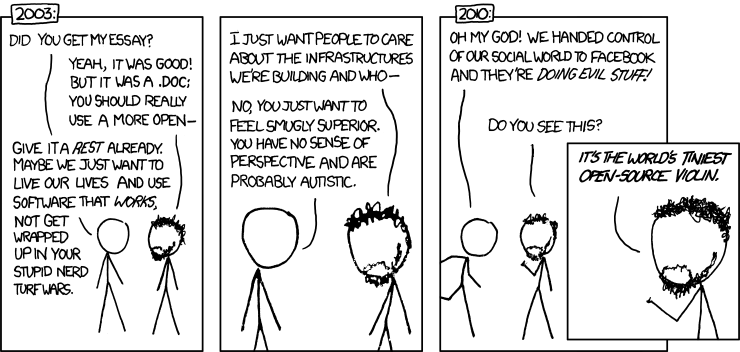
Infrastructures

I have defined Matthew’s Law (with thanks to Arthur C. Clarke, of course):

Matthew’s Law: “Any sufficiently advanced technical advice is indistinguishable from autism”

Because I saw this…

Infrastructures: “The heartfelt tune it plays is CC licensed, and you can get it from my seed on JoinDiaspora.net whenever that project gets going.“

(Via xkcd.com.)

We should probably all read “The Capitalist and the Entrepreneur” by Peter G. Klein

I owe some of my interest in organisations to a guy called Peter G. Klein.

Over 10 years ago, when I first decided that there was going to be a shift in the skills required to be an effective manager in an environment of cross-organisation coordination and open information, and when I was developing the initial ideas around ManageWithoutThem, it was in part driven from something Klein had written.

Specifically, I was skimming through an article call ‘0530 New Institutional Economics’ that Klein had written for some sort of encyclopaedia of economics. (It’s still available here)

The article opened my eyes to the possibility of a deep understanding of organisations and the fundamentals of why they exist. Something told me that this was the fundamental economics of the firm and that the ‘managed organisation’ (in the sense that piles and piles of management books that I was reading at the time assumed) was an anomaly.

I’ve since learnt some more of the political dynamic that keeps organised managed; but I still believe the ideas introduced in the original NIE article by Peter G. Klein are the fundamentals.

I even found myself, when often disagreeing with something a manager had said, saying ‘you don’t have a valid theory of the firm’ – until I realised how completely ridiculous I was starting to sound…. 🙂

Though I never actually finished reading the article. To be honest I went on a 10 year tangent. But with the release of Klein’s new collection of writings I’ve decided I’m going read every word. I’d also recommend managers do the same.

Links to purchase and download for free are available on the Mises.org blog: Why Klein’s Book Is an Event to Celebrate


Agile Manager on the risk of a Lean IT Financial Crisis

Interesting:

“Accounting rules dictate that inception has to be funded out of SG&A. What this means is that before we can spend out of a capital budget, we must spend some SG&A money first. It’s also important to bear in mind that the same is true at the other end of the delivery cycle: last mile tasks such as data migration can’t be capitalized; they also must be funded out of SG&A.

In effect, our SG&A budget (also known as operating expense, or OpEx) is leveraged with capital expense (CapEx). A contraction of OpEx proportionally reduces the CapEx accessible to us.”

And then the likelihood and mitigation:

“This “perfect storm” is more common than you might think. Mitigating exposure is done through a variety of different mechanisms.

One is to hedge the project portfolio by bringing several investments into the early stages of delivery and then putting them into operational suspense. This creates a deliberate OpEx expenditure at the beginning of a fiscal cycle (before risks of OpEx impairment are realized over the course of a year) to multiple project inceptions, and then rendering some of those investments dormant. This diversifies the IT project portfolio, allowing IT capability to shift among different projects should one or more of those projects be cancelled.”

– http://www.rosspettit.com/2010/04/mitigating-corporate-financial-risks-of.html

Thought of the day

Incentives beat intention.

— Post From My iPhone

‘New’ to MWT – ‘business intelligence’ is bunk

As I sometimes do, I’m adding a new subject to this blog. It’s in a group of topics that I would vaguely classify as ‘business topics that are a good idea until they get co-opted by IT vendors’.

Note that it’s IT vendors that break these concepts not IT. In many cases the concepts themselves have been formalised by the IT industry and should be seen as positve contribution that the IT industry has made to an understanding of organisational value – but then they ‘jump the shark’ and turn into bullshit.

I’m talking about Business Inteligence, Customer Relationship Management, Enterprise Resourse Planning, Master Data Management, etc.

For the first installment, of check out this link:

http://www.agilityissensible.com/2010/03/value-of-operational-intelligence.html

Agility is Sensible is a great resourse and the above post is no exception. The question is why are organisations stuck doing BI when they should naturally be planning for more opperational intelligence and realtime analysis?

– Posted using BlogPress from my iPhone

Location:Eton St N,Sutherland,Australia

IT as business process standardisation

“The Quarterly: CIOs debate whether IT should follow business change or lead it—in your case, for example, by furthering Shell’s globalization through IT standardization. What is your view?

Alan Matula: I see it somewhat differently. IT is like cement to the standardization activities. If you don’t cement changes with IT, then over time they will erode and revert back. IT provides the transparency that you need for driving standardization in a large, diversified corporation like Shell.”

– https://www.mckinseyquarterly.com/Business_Technology/BT_Strategy/Managing_IT_transformation_on_a_global_scale_An_interview_with_Shell_CIO_Alan_Matula_2559 

Breaking down innovation accountabilities

I’m attending an ‘innovation workshop’ today.  I’m looking forward to it but it also feels a little bit dirty.  Innovation is important – but I’m not sure it can be managed directly.  Management of anything politicises it; but with vague notions like ‘innovation’ it’s hard to establish the accountability required to balance the politics.

The session today will interesting.  I’m sure we will have the inevitable ‘what is innovation?’  discussion.  But I’m sure the normal process of people wondering how this might help their career will interfere with that.  Also, participants come from multiple vendor and client organisations so this will limit the sorts of ideas that can be discussed.

I’m not lamenting this dynamic –  it’s a natural part of work life.  But the trick will be to quickly convert this forum into a set of processes that ensure value is directed towards the sponsoring organisation.  I believe breaking up ‘innovation’ into a number of separate processes for which accountabilities can be established is the answer to this.

My first cut of the breakdown is as follows:

  1. Idea management process (capture, rate, sponsor, formally reject, and reward/recognition)
  2. Scanning (internal and external scanning of practices, technologies, and trends)
  3. A formal approach to analysing the organisation
  4. Initiative delivery process (to manage sponsored initiatives)
  5. Slack for brainstorming and black-market idea generation

Some of these, such as scanning, may have separate accountabilities for each organisation (to create competitive tension).  The idea management process may be owned by the sponsoring organisation (to ensure transparency to the sponsoring organisation).  Items 3 and 4 are likely to be tendered.  Item 5 may be measured by the innovation forum but be considered an accountability of business units.

Page 2 of 3

Powered by WordPress & Theme by Anders Norén